

Yes, you can walk on most flat roofs for occasional, light jobs such as clearing an outlet or checking for damage, but the typical house or extension flat roof is built for maintenance access only, not regular use. Stay off rooflights, the edges and wet or frosty surfaces, and never use it as a terrace without a structural check.
Key facts
- LABC, the body for local authority building control, says flat roofs are typically only designed to take light loads from snow, wind, self-weight and occasional access for maintenance and repair.
- The Health and Safety Executive says all roofs should be treated as fragile until a competent person has confirmed they are not, and rooflights are a particular hazard.
- Falls through fragile surfaces, mainly fibre-cement roofs and rooflights, account for 22% of fall-from-height deaths in construction, and people doing small, short maintenance jobs are over-represented.
- Using a flat roof as a roof terrace is not permitted development: government guidance says a raised platform over 0.3 metres “will include roof terraces” and needs planning permission.
- Where people do have access to a roof on a house, Approved Document K sets edge guarding at 1100mm high.
This guide explains which flat roof coverings cope with foot traffic, the warning signs that a roof will not take your weight, how to step out safely for a quick job, and when it makes more sense to ask a roofer. If you would rather have someone look at it for you, our flat roofing team covers SouthWest London.
Can You Walk on a Flat Roof Without Damaging It?
Usually yes, if the roof is in good condition and you only go up now and then. The difference that matters is whether the roof was designed for maintenance access or for pedestrian access.
Roofing certificates make this distinction clearly. The BBA certificate for Triflex’s walkway and terrace systems defines a limited access roof as one “subjected only to pedestrian traffic for maintenance of the roof covering, cleaning of gutters, etc”, and a pedestrian access roof as one with foot traffic and gatherings of people beyond what maintenance needs. Almost every flat roof on a London rear extension, garage, dormer or back addition is the first kind.
So stepping out to clear leaves from an outlet a couple of times a year is what the roof was built for. Using it as a sun deck, a route to the garden or a place to store pots and furniture is not. LABC warns that changing a flat roof into a balcony “might cause the structure to fail because of heavier loads imposed by more people and furniture”.
Which Flat Roof Coverings Can You Walk On?
Most modern coverings will take careful, occasional foot traffic. What changes is how easily each one is damaged and what is needed if you want to walk on it often. This table pulls together what manufacturers and suppliers say:
| Covering | Occasional maintenance visits? | Regular foot traffic? | What to watch for |
|---|---|---|---|
| Torch-on felt (reinforced bitumen membrane) | Yes, when in good condition. Bauder says its bitumen systems can sustain foot traffic and maintenance loads | Only with walkway protection or a system designed for it | Old felt that is cracked, blistered, split at the laps or soft underfoot |
| EPDM rubber | Yes. Rubber Roofing Direct says a rubber roof withstands light foot traffic for maintenance and window cleaning | Add bonded walkway pads or paving supports | Small stones in your soles that can puncture the membrane |
| GRP fibreglass | Yes, on a sound deck. GRP installer Strandek says even a thin GRP layer shows the capacity to withstand impact | Ask for a topcoat with gritted particles, which Strandek recommends to maximise grip | Smooth surfaces are a slip hazard when wet; cracks near edges and trims |
| Liquid-applied roofing | Yes, standard roof systems are rated for limited (maintenance) access | Use a dedicated walkway or balcony system with an anti-skid finish, such as the Triflex ProTerra range | Coating worn thin over joints and around outlets |
| Single-ply PVC or TPO | Yes, with care | Add walkway protection where people will walk | Sharp objects and dropped tools, because single-ply membranes are susceptible to tearing |
| Any roof with an unknown or tired deck | Only after a roofer has checked it | No | Bounce, soft spots or sagging between joists |
The covering is only half the story. A tough membrane laid over a rotten chipboard deck is still unsafe, because it is the deck and joists that carry your weight. If you are choosing a new covering and expect to use the roof, our comparison of EPDM vs GRP vs felt explains the trade-offs.
Is It Safe to Walk on a Flat Roof?
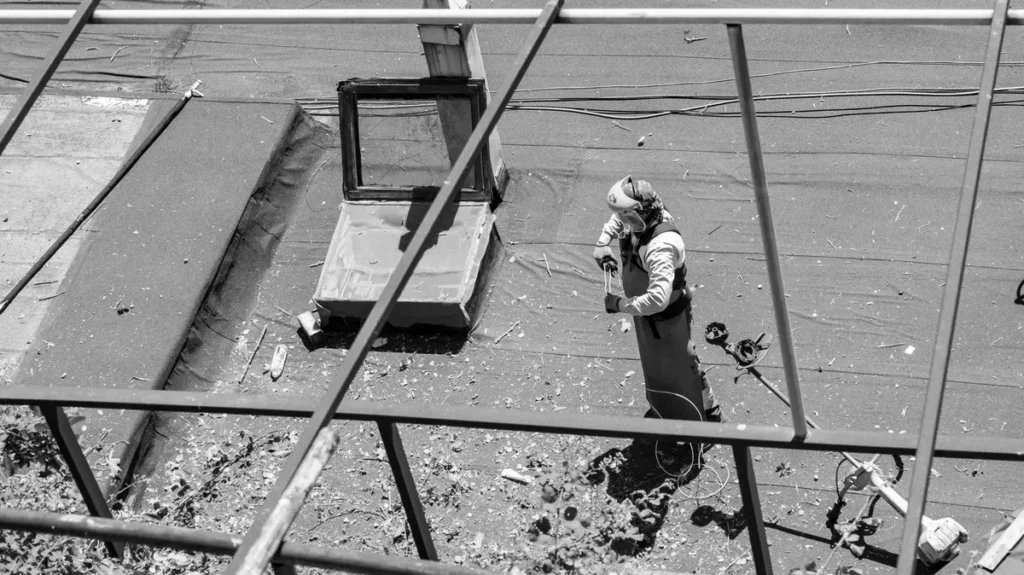
It can be, but there are three separate risks: falling off the edge, falling through the roof, and damaging the covering. A flat surface feels safe, which is exactly why people underestimate it.
Falling off the edge. Most house flat roofs have no parapet or rail. On building sites, the HSE expects flat roof edges to be protected by a secure double guardrail and toeboard. A homeowner stepping out of a window has none of that, so stay well back from the edge, especially on the side that drops to a patio or basement lightwell.
Falling through. The HSE lists the materials most likely to be fragile, including rooflights, wired glass, corroded metal sheets and chipboard where rotted. Its advice to builders is blunt: “Do not go onto fragile roof surfaces such as cement sheets or those with skylights.” Rooflights in the roof plane can be hard to see in some light, so know where every one is before you step out, and never step on or lean on one.
Damaging the roof. Heels, grit, dropped tools and ladder feet can split felt or puncture rubber. A small hole may not leak until weeks later, by which time water can have soaked the insulation and deck.
Weather matters too. The HSE tells roofers not to consider going on any roof in rain, ice, frost or strong winds. In a London November that rules out a lot of days, and wet leaves on a felt roof are as slippery as ice.
Signs Your Flat Roof Is Not Safe to Walk On
Check from a window first. If you see any of these, do not go out, and get the roof looked at instead:
- Dips where water sits after rain (see our guide to ponding on a flat roof), which often means a sagging deck
- Splits, open laps, blisters or bare patches in the felt
- Damp patches or staining on the ceiling of the room below
- A roof that bounces or feels soft when you test it with one foot from the window sill
- Moss, algae or wet leaves covering the surface
- Rooflights, vents or pipes close to where you would need to walk
- Cement sheet or corrugated panels, common on older garages and outbuildings
Older felt roofs on Victorian and Edwardian back additions are worth extra caution. Many have been overlaid more than once, and the original boards underneath can be decades old.
How Do You Get Onto a Flat Roof Safely?
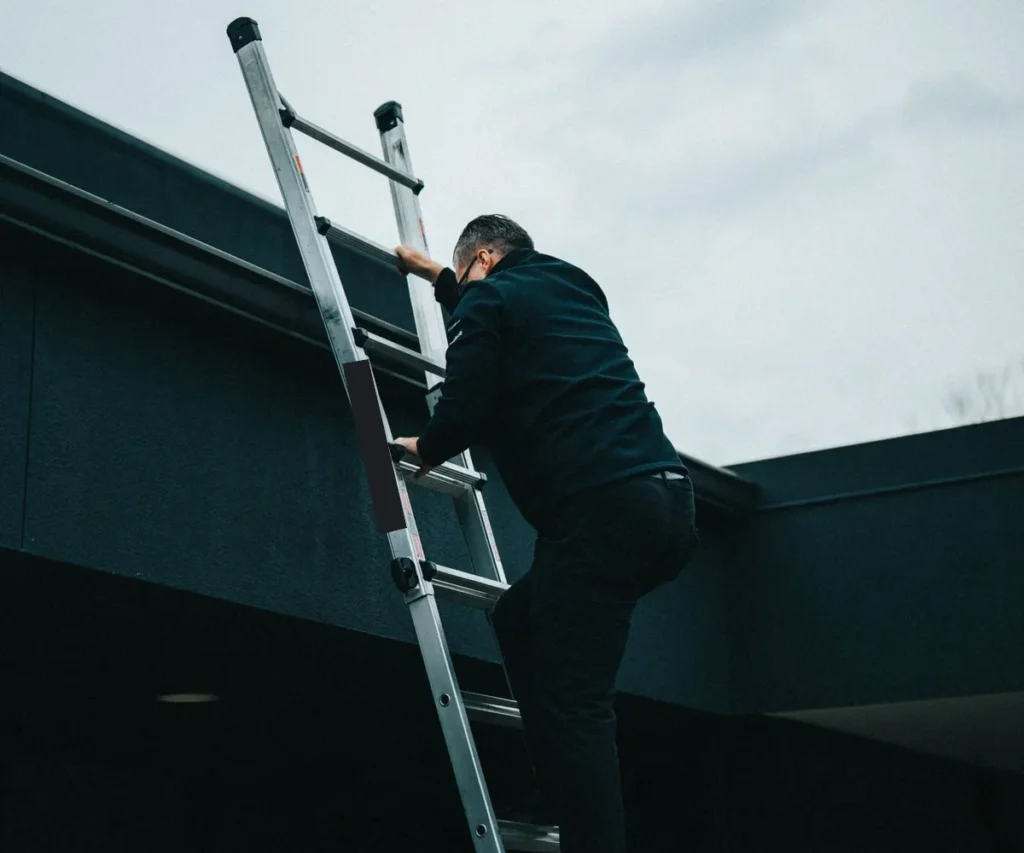
If the roof looks sound and the job is small, these steps keep the risk down. They follow HSE ladder guidance and manufacturers’ advice:
- Pick a dry, calm day. No rain, frost, ice or gusty wind.
- Set the ladder up properly. Use firm, level, clean ground, not bricks or blocks as packing, at the 1-in-4 angle (one unit out for every four up).
- Let it stick up above the roof. An access ladder should extend at least one metre above the landing point so you have a handhold as you step off.
- Protect the roof. If a ladder has to stand on the flat roof (to reach a gutter or window above), Permaroof suggests laying an offcut of carpet or a heavy bath towel under its feet first.
- Wear clean, soft-soled shoes. Check the soles for stones and grit before you step on.
- Step down gently and tread lightly. Do not jump onto the roof, and stay well away from the open edge and any rooflight.
- Keep it short and have someone with you. As a guide, the HSE suggests considering other equipment if a task means staying up a ladder for more than 30 minutes.
In practice, a quick outlet clear on a single-storey extension that you can reach from a window is often fine for a confident, careful homeowner. A roof two storeys up, one with no safe way on, or any job that involves tools, hot work or carrying materials is roofer territory. Our guide on when roofers need scaffolding explains what professional access looks like.
Not sure your flat roof will take your weight? JW Roofing Solutions inspects and repairs flat roofs across SouthWest London. We trace leaks to their source and give honest advice on whether a repair will do. Call +44 7467 800002 or get a free, no-obligation quote.
Who Should Do Common Flat Roof Jobs?
Here is a practical way to decide, job by job:
| Job | Reasonable DIY? | Better option |
|---|---|---|
| Clearing leaves from an outlet you can reach from a window | Often yes, on a sound, dry, low roof | A roofer if the roof shows any warning signs |
| Looking for storm damage | Look from a window or the ground only | A roofer or a drone roof survey, with no one walking on the roof |
| Finding the source of a leak | No | A roofer, because water often travels before it shows inside |
| Patching a split or blister | No | A roofer, matching the repair to the existing covering |
| Cleaning windows or gutters above the flat roof | With care, protecting the roof under the ladder | A cleaner or roofer with suitable access equipment |
| Using the roof as a terrace or balcony | No | A structural engineer, planning permission and building control first |
Can You Use a Flat Roof as a Roof Terrace?
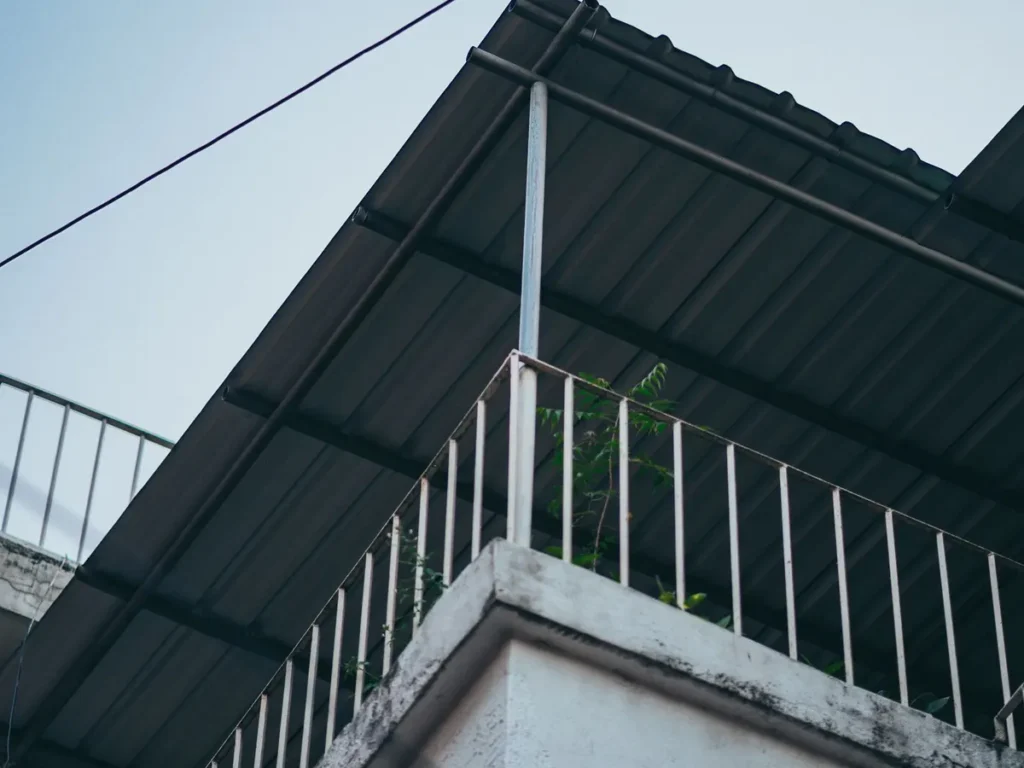
Not without checks and, in most cases, permission. A roof terrace is a change in how the roof is used, and it brings in structure, planning and Building Regulations.
- Structure: LABC says the roof and its supporting structure should be assessed by a qualified and experienced structural engineer before it is used as a balcony or terrace.
- Building Regulations: simply using an existing roof is usually not controlled work, but it becomes notifiable if the structure needs upgrading or a new door or access is created. Altering a window or door onto the roof is controlled work.
- Guarding: Approved Document K requires guarding where reasonably necessary for safety at the edges of any roof to which people have access, and sets it at 1100mm for external balconies and edges of roofs on single family homes.
- Planning: balconies, verandahs and raised platforms are not permitted development, and the guidance says a raised platform includes roof terraces. The Planning Portal also lists fire safety, security and structure as Building Regulations points for any external platform.
In practice, turning a standard extension roof into a terrace usually means a new, stronger deck, a covering designed for pedestrian traffic, proper drainage falls and a balustrade. That is a project, not a tweak.
What Happens If You Damage a Flat Roof by Walking on It?
Most foot damage is small and repairable if it is caught early. The bigger cost comes when a split goes unnoticed and water gets into the insulation and deck. Checkatrade’s June 2026 cost guide gives these typical UK repair prices per square metre:
| Flat roof covering | Typical repair cost per m² (UK, 2026) |
|---|---|
| Bitumen (felt) | £100–£140 |
| EPDM rubber | £120–£170 |
| GRP fibreglass | £130–£180 |
Source: Checkatrade roof repair costs. These are national averages, not JW prices, and London jobs often sit at the higher end. If the deck underneath has rotted, the job grows into the kind of work covered in our flat roof repair guide.
How long the covering itself will last depends on the material: see our guide to how long a felt roof lasts and when it needs replacing.
Frequently Asked Questions
Can you walk on a felt flat roof?
Usually yes, for occasional maintenance, if the felt is in good condition. Modern torch-on systems are made to take maintenance foot traffic, but old felt that is blistered, cracked or soft underfoot can split, so keep off it and have it checked.
Can you walk on an EPDM rubber roof?
Yes, EPDM takes light foot traffic for maintenance and window cleaning. Wear clean, soft-soled shoes, because a small stone in your sole can puncture the membrane, and fit walkway pads if you need regular access.
Can I put a ladder on my flat roof?
Only if the roof is sound, and with protection under the feet, such as an offcut of carpet or a heavy towel. Keep the ladder away from the roof edge and rooflights, and set it at the 1-in-4 angle.
Do I need planning permission to use my flat roof as a terrace?
Usually yes. Roof terraces count as raised platforms, which are not permitted development, and you will also need edge guarding at least 1100mm high and possibly Building Regulations approval if the structure or access changes.
How much weight can a flat roof hold?
There is no single figure for a house flat roof. Most are designed for snow, wind, their own weight and occasional maintenance access, so only a structural engineer can confirm whether yours will take more people, furniture or planters.
Should I walk on my flat roof to find a leak?
It is better not to. Water often travels under the covering before it shows inside, so the wet patch rarely sits under the hole, and extra foot traffic can make things worse. A roofer can trace the leak to its source.
Flat Roof Checks and Repairs in SouthWest London
If you are unsure whether your flat roof is safe to walk on, or you have spotted splits, ponding or a leak, JW Roofing Solutions can inspect it for you. We repair and renew flat roofs across SouthWest London in torch-on felt and liquid roofing, explain clearly whether a repair will last, and give you a written, itemised quote with no obligation. Call +44 7467 800002, get in touch online or read more about our flat roofing and roof maintenance services.
Need help with your roof? JW Roofing Solutions provides flat roof inspections, repairs and flat roofing in SouthWest London. Get a free, no-obligation quote.