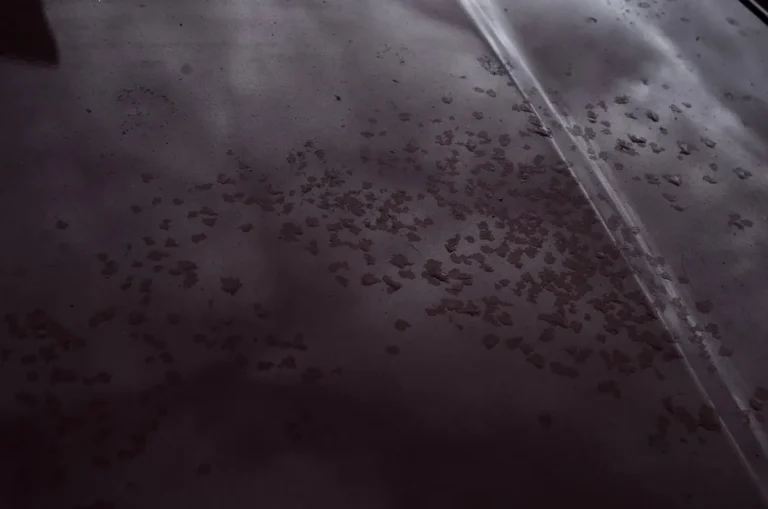


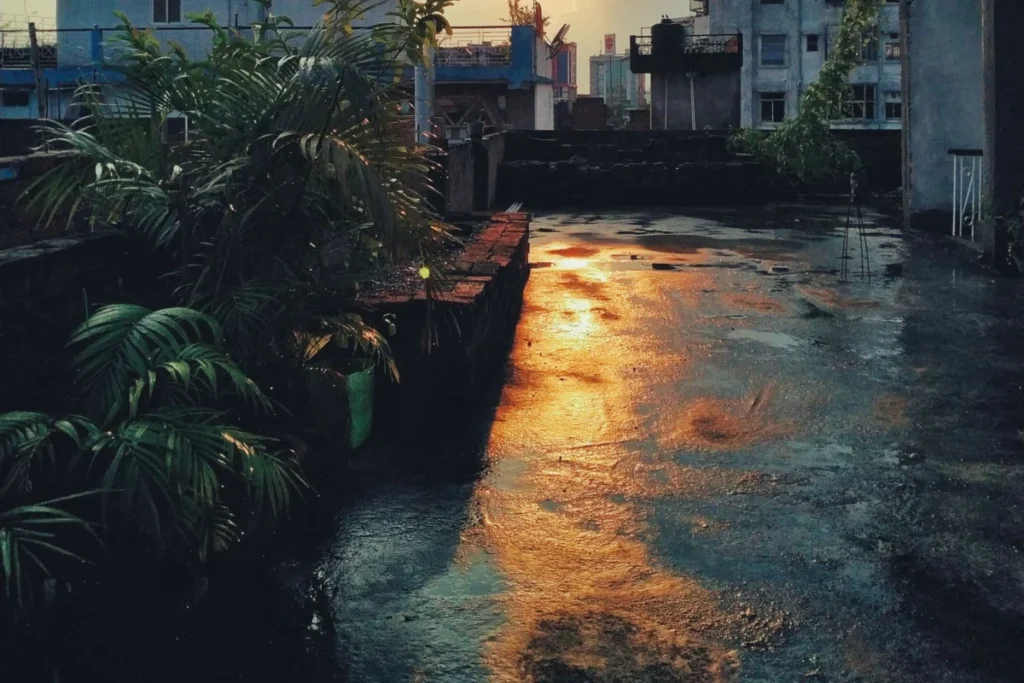
Ponding on a flat roof is rainwater still sitting on the surface 48 hours after the rain stops. Small puddles that dry within a day or two are normal. Water that stays longer, gets deeper or returns to the same spot every time means the roof’s falls, outlets or deck need attention.
Key facts
- Standing water that clears within 48 hours is not usually harmful. Ponding is deeper water, held for more than 48 hours, caused by poor falls or a sagging deck (Bauder, writing in RICS Modus).
- A flat roof is any roof with a pitch of 10° or less. It is normally designed with a 1:40 fall so that it still achieves 1:80 once built (LABC Warranty).
- A 1:40 fall means 25mm of drop for every metre of roof, as recommended in BS 6229 and BS 8217 (RICS Modus).
- The usual causes are falls that are too shallow, blocked or high-set outlets, a sagging deck and dead spots behind roof lights.
- Fixes run from clearing an outlet to re-laying the roof with proper falls. Checkatrade puts bitumen flat roof repairs at £100 to £140 per m² in 2026.
Across SouthWest London, flat roofs sit on rear extensions, back additions, dormers and garages behind Victorian and Edwardian terraces, and they are often only visible from an upstairs back window. This guide explains when ponding on flat roof surfaces is normal, how to check yours, what causes it and how it is fixed. If you would rather have someone look at it for you, our flat roofing service covers everything from outlet repairs to full re-roofs.
Is Ponding Normal on a Flat Roof?
A little water after heavy rain is normal. Water still there two days later is not. LABC Warranty says rain should run across a flat roof as a thin film perhaps only a few millimetres deep, and in a cloudburst it can briefly pool around an outlet for a few minutes until the outlet catches up.
The roofing industry splits water on a flat roof into two kinds. Richard Clennell of membrane manufacturer Bauder, writing in RICS Modus, defines standing water as a small amount held behind a lap or detail for no more than 48 hours after the rain ends, which is not considered harmful. Ponding water is a larger amount, deeper than the laps, that collects because of poor falls or deck deflection and stays for more than 48 hours. Waterproofing manufacturer Triflex uses the same 48-hour line.
| What you see | Usually normal | Usually a problem |
|---|---|---|
| How long it lasts | Gone within 48 hours of the rain stopping | Still there after 48 hours |
| How deep it is | A shallow film or water held behind a lap | Deeper than the laps and spreading |
| Where it sits | Briefly around an outlet during a downpour | The same low spot every time, often mid-roof, by a wall or behind a roof light |
| After it dries | Clean surface | Rings of dirt or algae marking the outline |
| Inside the house | Dry ceiling | Damp patches or staining below the roof |
| Over time | Same size after every storm | Getting bigger each year as the deck deflects |
Permaroof notes that circles of algae or dirt on the surface are a giveaway that ponding is happening, even when the roof is dry when you look at it.
How Can You Tell If Your Flat Roof Has a Ponding Problem?
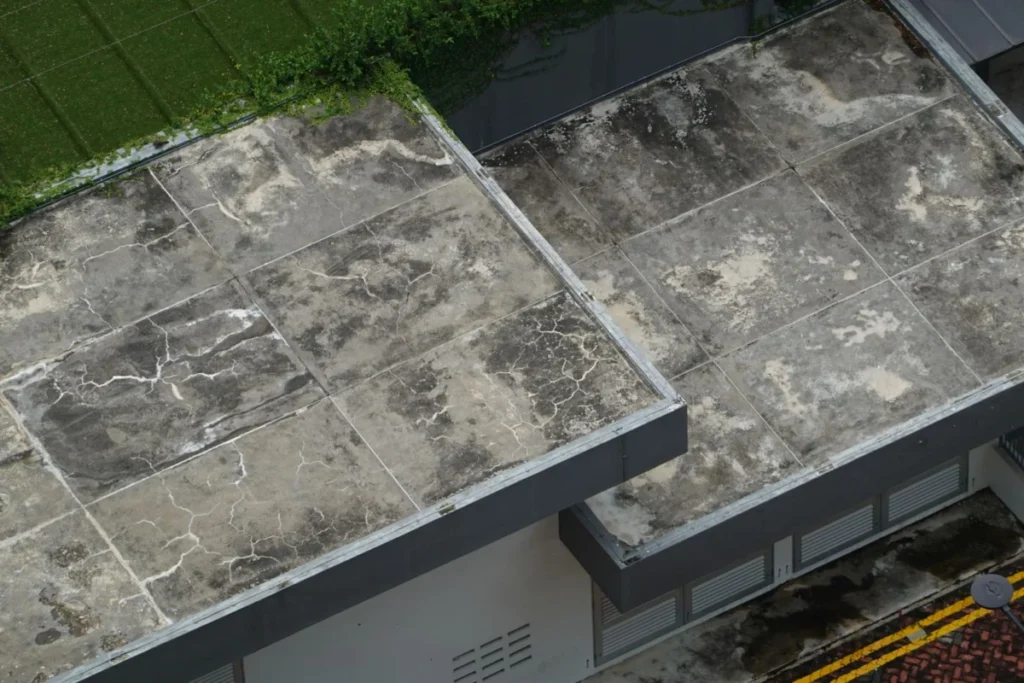
Do a simple 48-hour test after the next proper downpour. You only need a phone camera and a safe place to look from.
- Note the time the rain stops. Light drizzle does not count; wait for a heavy shower.
- Photograph the roof from a safe spot, such as an upstairs window, or from a ladder that is footed or tied at the roof edge. Do not walk on the roof if you are unsure it will take your weight.
- Take the same photo again at 24 hours and 48 hours, from the same position, so you can compare them.
- If water is still there at 48 hours, note how big the pond is and where it sits: in the middle, next to an outlet, along a wall or behind a roof light.
- Once it has dried, look for dirt rings, green algae or moss marking the edge of the pond.
- Check inside, on the ceiling below the roof and in any cupboard or loft space beside it, for damp or staining.
- Keep the photos. They help a roofer work out the cause and show whether the pond is growing.
What Causes Ponding on a Flat Roof?
Ponding almost always comes down to one of five things: not enough fall, outlets that are blocked, outlets that sit too high, a deck that has sagged, or something that interrupts the fall.
- Falls that are too shallow. LABC Warranty says it is normal practice to design flat roofs at 1:40 so they achieve 1:80 in service, allowing for site inaccuracies and minor deflection. Where 1:80 is not reached, water ponds. Where two slopes meet, the cross fall is shallower still: a main fall of 1:80 gives only 1:113 along the join.
- Blocked outlets, gutters and hoppers. Leaves, silt and debris build up around outlet guards, and the dirt that collects in a pond then washes into the outlet and makes it worse.
- Outlets set too high. LABC Warranty points out that when the outlet is detailed after the main roof is laid, the extra layers can leave a step that water cannot get over.
- A sagging deck. Timber boards that have got wet, joists that have deflected, or insulation that has compressed under heavy loads can all create dips. Soprema notes that insulation that is overloaded can compress and dent, leading to ponding.
- Dead spots behind obstructions. The area just uphill of a roof light, a chimney or a plinth for plant often holds water unless a drainage cricket (a small double-triangle ridge) was built in to divert it.
On London period homes there is often an extra factor: many extension and back addition roofs have been re-covered more than once, and each new layer can change the levels around outlets and upstands. If your roof has dips near the edges where water runs into a gutter, our guide to felt at the eaves and gutter covers a related problem on pitched roofs.
Why Is Ponding Bad for a Flat Roof?
Ponding shortens the life of the roof and makes leaks more likely. LABC Warranty lists the increased risks created by ponding:
- Faster leaks. If the membrane is punctured under a pond, the depth of water builds a head of pressure that pushes water into the building faster.
- Progressive deflection. The weight of the water makes the deck bend, which deepens the pond, which adds more weight, until the deck is damaged or the roof is put right.
- Blocked outlets. Ponds collect dirt, leaves and algae that later wash into the outlets.
- Freeze and thaw damage. Frozen ponds stop the membrane moving with the rest of the roof, and if this happens over a lap it can force the joint open.
- Slips. Wet, algae-covered or icy areas make the roof more dangerous for anyone who needs to maintain it.
Some roof coverings cope with water better than others. MyBuilder notes that basic single-layer mineral felt is more susceptible to ponding water than modern torch-on systems, and Triflex says some membranes deteriorate when exposed to standing water for long periods. Ponding can also affect a guarantee: Bauder told RICS Modus that some insurers will not sign off a roof if they see water on the surface. Our guide to roof guarantees explains what to check.
Water sitting on your flat roof for days? JW Roofing Solutions will trace where it is coming from and why, and tell you honestly whether a repair will do or the roof needs re-laying. Call +44 7467 800002 or request a free, no-obligation quote.
How Do You Fix Ponding on a Flat Roof?

Match the fix to the cause, and always rule out the cheapest cause first. A blocked outlet can make a well-built roof pond; re-laying a roof will not help if the outlet is still blocked.
| Cause | Fix | DIY? | Typical UK cost (2026) |
|---|---|---|---|
| Blocked outlet, gutter or hopper | Clear leaves and silt, refit the outlet guard | Yes, if you can reach it safely | Gutter repair and cleaning £80–£150 (MyBuilder) |
| Outlet too high or too few outlets | Reset the outlet flush with the roof, or add an outlet at the low point | No | Priced per job |
| Shallow dip in an otherwise sound roof | Build up the low area and re-cover it, or overlay that section | No | Small patch around 4m² from £200 (MyBuilder); bitumen repairs £100–£140 per m² (Checkatrade) |
| Dead spot behind a roof light or plinth | Form a drainage cricket to divert water | No | Priced per job |
| Whole roof laid too flat | Strip and re-lay with falls formed by tapered insulation, screed or the structure | No | House flat roof refelt £1,500–£4,500 (MyBuilder) |
| Sagging or rotten deck | Replace boards, check joists, then re-cover with falls | No | Replacement boarding £20–£40 per m² extra (MyBuilder) |
Checkatrade’s repair rates are based on areas up to 3m², exclude VAT and access equipment, and come down per m² on bigger repairs. London prices tend to sit towards the top of most ranges.
Two points from the manufacturers are worth knowing before you agree a fix. First, Bauder warns that adding flat insulation boards will not improve the falls; if the roof was laid flat, tapered insulation is usually the best answer, and extra outlets at the low points are an option where practical. Second, BS 6229 allows the fall to be created by sloping the structure, screeding or tapered insulation, so ask your roofer which method they plan to use and why.
Can You Fix Flat Roof Ponding Yourself?
Some of it, yes. The cheapest and most common fix, clearing a blocked outlet or gutter, is a reasonable DIY job if you can reach it safely from a well-footed ladder or a window. You can also sweep standing water towards an outlet with a soft broom as a short-term measure.
Leave it to a roofer if:
- the water is still there 48 hours after you have cleared the outlets
- you can see damp or staining inside
- the roof feels soft or springy, which suggests the deck underneath is wet or rotten
- the pond is getting bigger from one storm to the next
- you would need to stand on the roof to do the work
Never cut or puncture the membrane to let a pond drain, and avoid DIY levelling products unless you know what the roof is covered with and the covering is sound; on the wrong membrane they can trap water or fail to bond.
Repair or Re-Lay? What We Would Do
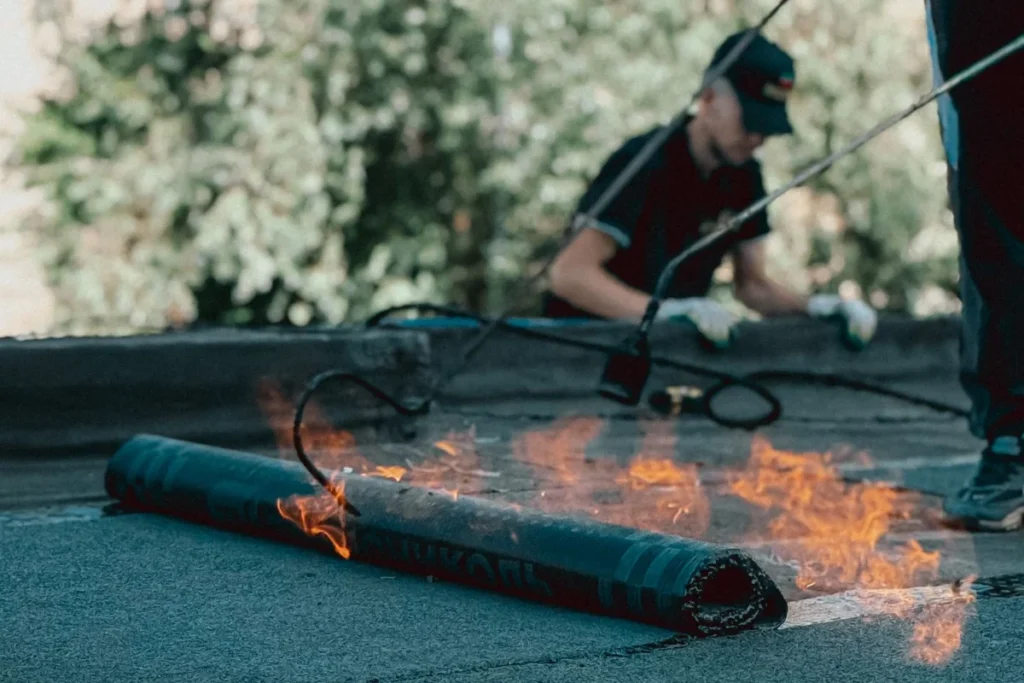
If the roof covering is in good condition and only one area ponds, we would clear and test the outlets first, then deal with that low spot locally. If the covering is already cracked, blistered or patched, and water ponds in several places, re-laying with proper falls is usually better value, because most of the cost of a repair is getting set up and the falls will still be wrong afterwards. MyBuilder puts a typical flat roof replacement at £2,800 to £7,500, averaging £75 per m².
Our flat roof repair guide covers other common faults, and our comparison of EPDM vs GRP vs felt will help if you are choosing a new covering.
If water sits on your flat roof for more than a day or two after rain, a flat roof inspection is usually one of the cheaper roof checks: see our roof inspection cost guide for 2026 prices.
If ponding has already caused a leak, our step-by-step guide on how to fix a leaking flat roof explains how to find it and what a temporary patch can and cannot do.
Frequently Asked Questions
Is ponding normal on a flat roof?
A little water that drains or dries within 48 hours of the rain stopping is normal on most flat roofs. Water that is still there after 48 hours, is deeper than the laps in the membrane or keeps returning to the same spot is ponding, and it points to a problem with the falls, the outlets or the deck.
How long should water sit on a flat roof?
No longer than 48 hours after the rain ends. That is the line used in roofing guidance to separate harmless standing water from ponding that shortens the life of the waterproofing.
How do I get water off a flat roof?
Start by clearing the outlets, gutters and hoppers, because a blockage is the cheapest cause to fix. You can push water towards an outlet with a soft broom as a short-term measure, but never pierce the membrane to let a pond drain. If the water keeps coming back, the roof needs better falls or an extra outlet.
Can ponding cause a flat roof to leak?
Yes. LABC Warranty explains that a pond builds a head of pressure that pushes water faster through any puncture, and freeze and thaw cycles can force open laps in the membrane. The extra weight can also make the deck sag further, which deepens the pond.
How much does it cost to fix ponding on a flat roof?
It depends on the cause. MyBuilder puts gutter repair and cleaning at £80 to £150 and a small patch repair from around £200, while Checkatrade lists bitumen flat roof repairs at £100 to £140 per m². If the whole roof has to be re-laid with proper falls, MyBuilder gives £2,800 to £7,500 for a typical flat roof replacement.
Will ponding affect my flat roof guarantee?
It can. Bauder told RICS Modus that some warranty insurers will not sign off a roof if they see water sitting on the surface. If a new roof ponds, report it to the installer straight away and keep dated photos.
Does house insurance cover a leak caused by ponding?
It depends on your policy, so read the wording and speak to your insurer before any work starts. Dated photos of the ponding and of any damage inside will help whichever way the claim goes.
Flat Roof Ponding Help in SouthWest London
JW Roofing Solutions repairs and re-lays flat roofs across SouthWest London using torch-on felt and liquid roofing systems. We will find out why the water is sitting on your roof, explain whether a simple repair will solve it, and give you a clear, written quote with no obligation. Call +44 7467 800002, get in touch online or read more about our flat roofing service.
Need help with your roof? JW Roofing Solutions provides flat roof ponding repairs and flat roofing in SouthWest London. Get a free, no-obligation quote.