

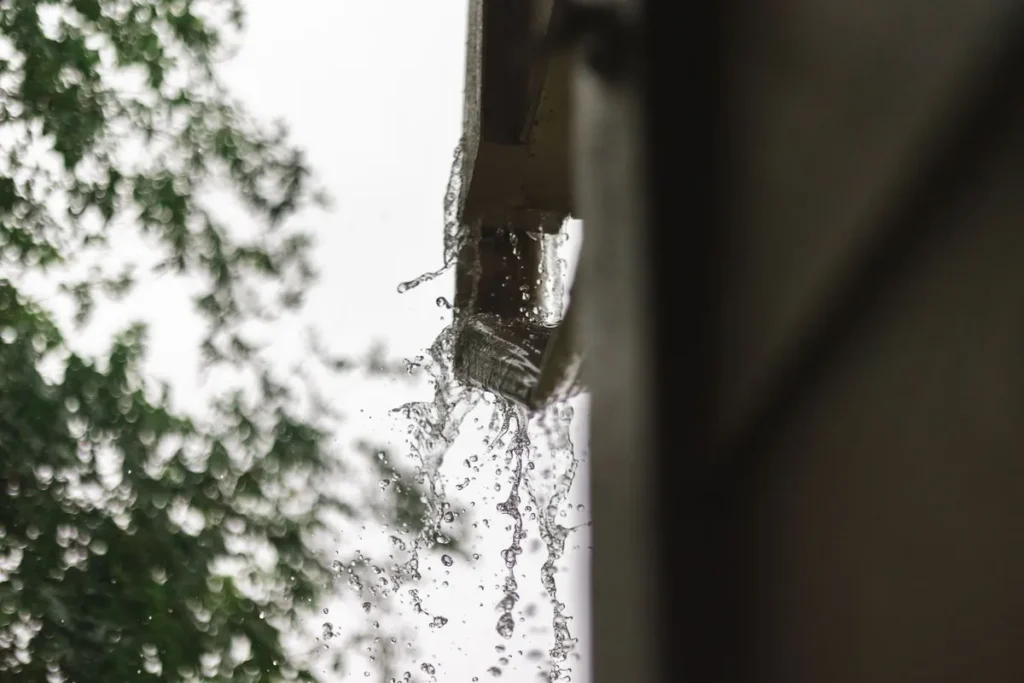
A gutter overflowing in heavy rain usually has one of six causes: a blocked outlet, a blocked downpipe, a gutter with no fall, a gutter too small for the roof, water overshooting the front edge, or fast water at a corner or valley. A brief spill in a cloudburst can be normal, but overflowing in ordinary rain is a fault worth fixing.
Key facts
- Building Regulations guidance says gutters should be laid with any fall towards the nearest outlet, and that any overflow above the design capacity should be discharged clear of the building (Approved Document H, paragraphs 1.6 and 1.7).
- Eaves gutters are sized for a two-minute storm. The design figure for London is 0.022 litres per second per square metre, and the Metal Gutter Manufacturers Association says eaves gutters can be allowed to overflow in extreme circumstances.
- A standard 100mm half-round gutter, laid level with the outlet at one end, should drain no more than 37 square metres of effective roof area, according to Table 2 of Approved Document H.
- The MGMA allows for a 50 percent reduction in outlet capacity where a leaf guard is fitted, because guards soon get covered in leaves.
- Most fixes are small. Checkatrade’s October 2026 guide puts a gutter clean at £50 to £120 for a small terraced house and a leaking joint repair at £60 to £90.
This guide shows you how to work out the cause from where the water spills, what each fix involves and costs, and when it is a job for a roofer. If you would rather someone simply looked at it, our guttering service covers gutter cleaning, repairs and replacement across SouthWest London.
Is It Normal for Gutters to Overflow in Heavy Rain?
Sometimes, yes. An eaves gutter is designed for a short, very heavy downpour, and the design rules accept that a rare storm will be bigger than that. If your gutter overflows in steady rain, or every time it rains hard, something is wrong.
The MGMA explains that UK gutter design uses the rainfall likely in a two-minute storm, typically a warm-day thunderstorm in early or late summer. Surprisingly, the south east and East Anglia have a design rainfall more than twice that of some parts of Scotland, so London gutters have to cope with some of the most intense bursts in the country.
Approved Document H plans for this: gutters should be laid so that overflow caused by above-normal rainfall is discharged clear of the building. Heavy downpours are also becoming more common. Historic England notes that, with rainfall intensity rising, the original capacity of gutters and downpipes may be inadequate on older buildings.
Our rule of thumb: if it spills for a few minutes in a thunderstorm and the water falls clear of the wall, keep an eye on it. If it spills in ordinary rain, always at the same spot, or soaks the brickwork, find the cause.
Why Is My Gutter Overflowing? Find the Cause From Where It Spills
Where and when the water comes over tells you most of what you need to know. Watch the gutter in a downpour, from the ground or an upstairs window, and match what you see to this table.
| Where or when it overflows | Most likely cause | What to check |
|---|---|---|
| At or next to the downpipe outlet | Blocked outlet or blocked downpipe | Leaves packed in the outlet; water backing up or barely trickling out at the bottom of the pipe |
| In the middle of a run | A sag or low spot, often a loose or missing bracket | Water still standing in that spot the day after rain |
| At the end furthest from the outlet | No fall, or a fall the wrong way | A string line or level along the run |
| Along the whole length, even when clean | Gutter too small for the roof area | Roof size against gutter size (see the sizing table below) |
| At a corner | Fast water shooting past the angle | Water jumping the corner only in hard rain |
| Below a valley or steep slope | Concentrated flow, or water overshooting the gutter | Water hitting or missing the front edge of the gutter |
| Behind the gutter and down the wall | Gutter set too low or too far out, or rotten felt at the eaves | Daylight between the tiles and the gutter; stains on the fascia |
| Dripping at joints only in heavy rain | Water backing up from a blockage and finding tired seals | Staining under unions and corners |
Water running down behind the gutter is often an eaves problem rather than a gutter problem. Our guide on whether roofing felt should go into the gutter explains how rotten felt and missing eaves trays cause it.
What Are the 6 Most Common Causes, and How Do You Fix Each One?
1. Leaves and moss blocking the gutter or outlet

This is the most common cause by far. The SPAB says rainwater fittings usually cause problems because of poor maintenance, with gutters, downpipes and gullies blocked by leaves, moss and debris such as broken tiles. Even a small clump at the outlet can back up the whole run.
The fix: scoop out the debris, clear the outlet and flush the run with water. FloPlast advises clearing plastic gutters of leaves at least once a year, and the SPAB recommends clearing particularly after the autumn leaf fall. On tree-lined streets, twice a year is more realistic.
2. A blocked downpipe
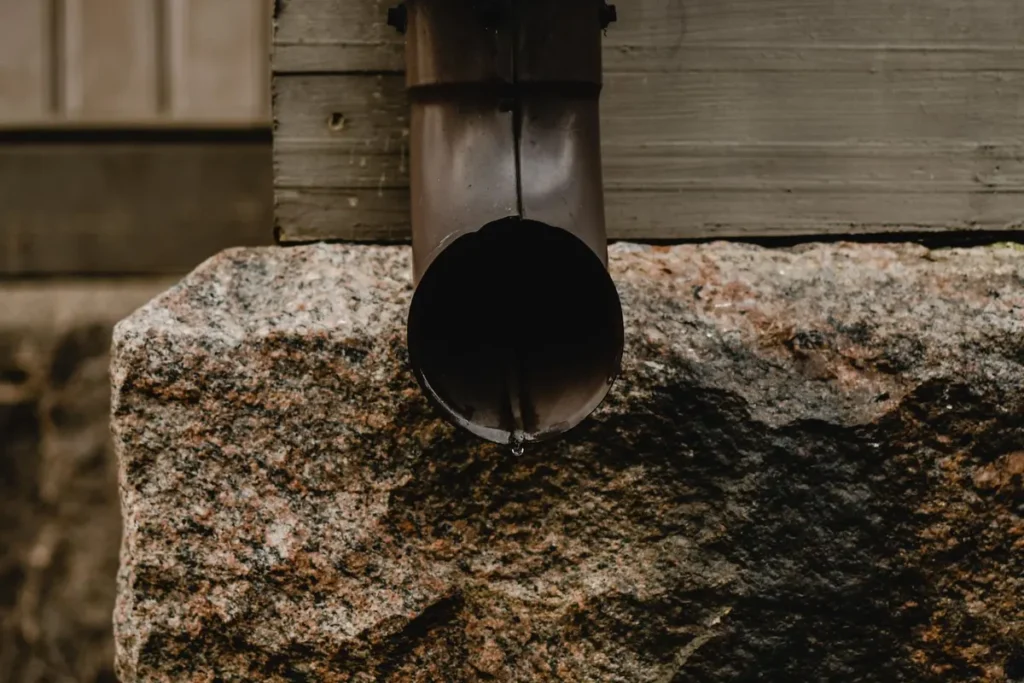
A gutter can be spotless and still overflow if the downpipe is choked at a bend, at the offset under the eaves or at the gully at ground level. FloPlast notes that when a downpipe is blocked, water leakage may occur at joints, so dripping unions can be a symptom rather than the fault. Historic England adds that downpipes connecting straight into underground drains may become blocked over time.
The fix: run water into the gutter at the outlet. If it rises in the gutter instead of rushing out at the bottom, the pipe is blocked. Clear the grid over the gully first, then rod or flush the pipe. If the gully itself will not drain, the blockage is underground and needs a drainage engineer.
3. The gutter has lost its fall
Gutters can be fitted level or with a gentle slope, but they must never fall away from the outlet. Kalsi’s installation guide says to fit plastic half-round gutter no flatter than 1:600, with 1:350 (about 3mm per metre) recommended, so a 6m run drops about 18mm, with brackets no more than 600mm apart. Marley’s installation guide says its gutters can be installed level or with a gradient of 1:600 or 1:350.
Over the years brackets loosen, fascias rot and runs start to sag. The Department for Communities lists a gutter set with its inner edge lower than the outer, or with the falls wrongly directed, as a classic cause of water running over in heavy downpours.
The fix: re-set or replace brackets along a string line so the run falls towards the outlet. If the fascia is soft, it needs repairing first or the new brackets will pull out.
4. The gutter is too small for the roof
If the gutter is clean, falls the right way and still overflows along its length in heavy rain, it is probably undersized. Approved Document H sizes gutters by “effective roof area”. For a pitched roof, that is the plan area of the slope multiplied by 1.29 at 30 degrees, 1.50 at 45 degrees and 1.87 at 60 degrees, because steeper roofs catch more wind-driven rain.
| Half-round gutter size | Smallest outlet | Maximum effective roof area | Flow capacity |
|---|---|---|---|
| 75mm | 50mm | 18 m² | 0.38 litres/sec |
| 100mm | 63mm | 37 m² | 0.78 litres/sec |
| 115mm | 63mm | 53 m² | 1.11 litres/sec |
| 125mm | 75mm | 65 m² | 1.37 litres/sec |
| 150mm | 89mm | 103 m² | 2.16 litres/sec |
A worked example: a rear roof slope that measures 6m along the gutter and 5m from gutter to ridge on plan covers 30 square metres. At a 45 degree pitch, that becomes 45 square metres of effective area, which is more than a 100mm gutter with one end outlet is meant to take.
The fix: you do not always need a bigger gutter. Moving the outlet to the middle of the run means each half only carries its own share of the roof (paragraph 1.5), and a second downpipe can do the same job. Otherwise, a deeper or wider profile is the answer.
5. Water is overshooting the gutter
On steep slopes, rain can leave the roof so fast that it flies over the front of the gutter, and a gutter fixed too low makes this worse. Marley’s installation guide warns that when a gutter is fitted to a fall, the top must not drop so far below the roof tiles that water passes over it.
The fix: re-position the gutter under the line of the roof, or change to a deeper profile that catches more of the flow.
6. Fast water at corners and valleys
Corners slow water down. The MGMA says corners have an effect on flow that must be taken into account, however close they are to the outlet. A roof valley also pours the water from two slopes onto one short stretch of gutter.
The fix: a splash guard or deflector at the corner, an extra outlet near it, or a hopper under the valley. Historic England suggests installing a hopper to stop overshooting from a valley gutter, or adding an overflow outlet to a hopper as a fail-safe.
How Do You Stop Water Overflowing From Gutters During Storms?
Find where the water spills first, then fix that cause before the next storm. In order of cost, the usual fixes are:
- Clear leaves, moss and silt from the gutter and outlets, ideally in late autumn once the trees are bare.
- Check the downpipe is running freely; our guide on how to unblock a downpipe shows how to find and clear a blockage from the ground.
- Re-set any gutter that has lost its fall or sags between brackets, so water runs towards the outlet instead of pooling.
- Fit a splash guard at a corner or valley, or a hopper under a valley, where fast water overshoots the gutter.
- Add an extra outlet and downpipe, or move to a deeper gutter profile, if the gutter is simply too small for the roof area it drains.
The first two steps are safe DIY jobs from the ground for many homes. Re-setting falls, adding outlets and changing gutter sizes are work at height and are best left to a roofer, who can see the whole run and tell you honestly which fix will actually stop the overflow.
How Can You Check Your Gutters Safely?
You can do most of the detective work from the ground. Only climb if it is a single storey, the ground is firm and you are confident on a ladder.
- Watch it in a downpour. The SPAB says fittings are best checked for leaks in heavy rain. Note exactly where the water comes over and use the table above.
- Look at the walls and ground. The National Lottery Heritage Fund’s maintenance guide says splashes of soil on the base of walls show water is not being caught by the gutter, and staining or algae around joints points to a faulty connection.
- Check for standing water. On the next dry day, look from an upstairs window for water sitting in the gutter. That marks a sag or a blocked outlet.
- Check the bottom of each downpipe. Clear leaves off the gully grid and make sure water is getting away.
- Single storey only: test with a hose. Run water in at the high end and watch it travel to the outlet. HSE guidance says a ladder is only for low-risk, short jobs, and if you would be up a leaning ladder for more than 30 minutes at a time, other equipment is recommended.
- Leave anything higher to a roofer. Two and three storey gutters, gutters over conservatories and hidden parapet gutters need proper access. Our guide to working on a roof without scaffolding explains the options.
Gutters spilling over every time it rains? JW Roofing Solutions clears, repairs and replaces gutters across SouthWest London. We find the real cause first, and if a clean is all it needs, we will tell you. Call +44 7467 800002 or get a free, no-obligation quote.
Why Do Gutters on London Victorian Terraces Overflow So Often?

Older London houses combine intense design rainfall with old cast iron gutters, hidden valleys and parapets. Each of these adds risk.
- Rusting cast iron. The SPAB notes that gutters can fracture where bolt fixings rust, and eaves gutters supported by too few brackets sag. A 2023 study of a historic building’s cast iron rainwater system found that corrosion can reduce its capacity, making gutter overtopping more likely.
- Valleys, parapets and butterfly roofs. Many terraces drain a hidden valley or parapet gutter through one hopper. When that outlet blocks, the water has nowhere to go but over the top. Our guide to box and parapet gutters covers these in detail.
- Big street trees. Leaves and seeds land in the gutter every autumn, and moss washes down off older slate and tile roofs.
- Extensions and loft conversions. A new dormer or rear extension can send more roof area into an old gutter than it was ever sized for.
If your house is listed, check before you change materials. Historic England says like-for-like replacement of a cast iron gutter in cast iron does not need listed building consent, but wholesale replacement in PVCu would need it. In a conservation area, ask the council too. The SPAB’s view is that repair is preferable to replacement where feasible, to keep the historic fabric.
How Much Does It Cost to Fix an Overflowing Gutter?
Most overflowing gutters are fixed with a clean, a few brackets or a resealed joint, which costs far less than replacement. These are published 2026 UK averages from Checkatrade and MyBuilder, not our prices. London jobs and anything needing scaffolding tend to cost more.
| Fix | DIY or roofer? | Typical UK cost (2026) | The right fix when |
|---|---|---|---|
| Clear gutters and outlets | DIY on a bungalow; otherwise a professional | £50 to £120 for a small terraced house (Checkatrade) | You can see leaves or moss, or water spills at the outlet |
| Reseal a leaking joint | Roofer or gutter fitter | £60 to £90 (Checkatrade) | Drips only at unions and corners |
| Re-set the fall or replace brackets | Roofer or gutter fitter | Brackets £10 to £15 each plus labour; around £19 to replace one bracket (Checkatrade) | Water sits in a sag or spills at the far end |
| Replace a single length | Roofer or gutter fitter | £120 to £180 on a medium semi (Checkatrade) | One cracked, warped or split section |
| Repair cast iron guttering | Specialist | £60 to £70 per metre (Checkatrade) | Period houses, listed buildings and conservation areas |
| New uPVC system, larger profile or extra downpipe | Roofer or gutter fitter | Around £1,000 for 15 to 20m and three downpipes (Checkatrade); scaffolding can add £250 to £500 (MyBuilder) | The gutter is undersized, or failing along most of the run |
Not sure whether to patch or replace? Our guide to gutter repair vs replacement covers the signs that a whole run has had its day.
Will Gutter Guards Stop My Gutters Overflowing?
They can help under trees, but they can also make overflow worse in heavy rain. The MGMA’s design guidance assumes a 50 percent cut in outlet capacity where a leaf guard is fitted, because guards quickly get a waterproof covering of leaves.
The SPAB says it can be advantageous to fit plastic leaf guards to gutters or wire balloons above downpipes. A wire balloon in each outlet is a cheap first step that stops leaves getting into the pipe. Full-length guards make sense only once the gutter is clean, falling the right way and big enough, and they still need checking.
What We Would Do About an Overflowing Gutter
We work from the cheapest likely cause to the most expensive, so you only pay for what the gutter needs:
- Clear the gutter, outlets and hoppers, then water test every run.
- Check each downpipe and gully runs freely.
- Check the fall and brackets with a line, and look at the fascia behind.
- Look at where the roof meets the gutter: overshoot, corners, valleys and the felt at the eaves.
- Only then measure the roof against the gutter size and talk about a deeper profile or an extra downpipe.
If you also want the rest of the roof looked over while someone is up there, our guide to roof inspection costs explains what a check covers.
Can Overflowing Gutters Cause Damp Inside the House?
Yes. Water spilling over a gutter runs down the same strip of wall every time it rains, and once the brickwork is saturated it can soak through to the inside. Government guidance quoted by Lansdown Associates (April 2026) defines this as penetrating damp, and Historic England notes that leaking gutters or drainpipes are often the cause of damp walls. Peter Cox adds that solid brick walls, common on Victorian and Edwardian London terraces, are the most affected because there is no cavity to stop the water.
Signs that the damp inside comes from the gutter above:
- A stain at ceiling level or around an upstairs window, in line with the gutter, a joint or a downpipe.
- A patch that grows during or after heavy rain and fades slowly in dry weather.
- Outside: dark staining, green algae or washed-out mortar on the wall below the gutter.
- Rotten fascia boards or wet insulation at the edge of the loft, where water has run behind the gutter.
SPAB guidance warns that leaks from parapet and valley gutters are particularly serious, because the space below is warm, poorly ventilated and holds the ends of the roof timbers; see our guide to box gutters if yours is hidden behind a parapet. Fix the gutter first and let the wall dry before replastering or redecorating. If the patch is in the loft rather than on a wall, compare it with our guide to condensation on roofing felt.
How Urgent Is an Overflowing Gutter?
More urgent than it looks. Cadw advises that overflowing gutters and hopper heads can lead to damp walls and decay, and the problem should be identified and addressed without delay. A guide to how quickly to act:
- Same day: water coming through a ceiling, near electrics, or a gutter hanging loose over a path.
- Within a week or two: overflowing in every heavy shower, water running behind the gutter, or a damp patch inside.
- Before winter: an occasional spill in a cloudburst, leaves in the outlet, or a sag you can see from the ground.
Most overflow is a blockage, so clearing the gutter and outlet in autumn prevents most of it. If the gutter is clear and still overflows, it needs its fall reset, a bigger outlet or an extra downpipe; our gutter repairs team covers SouthWest London from our base in Balham (SW12), on 07467 800002.
If water is coming through a ceiling rather than over the gutter edge, the cause may be in the roof itself. Our guide to a roof leaking in heavy rain covers the eight usual causes and what to do the same night.
Frequently Asked Questions
Why does my gutter overflow when it is not blocked?
The usual reasons are a blocked downpipe, a gutter that has lost its fall, a gutter too small for the roof, or water overshooting the front edge on a steep roof. Watching where the water spills in a downpour narrows it down quickly.
Is it normal for gutters to overflow in heavy rain?
An occasional spill in a very intense downpour can be normal, because eaves gutters are designed for a short two-minute storm and can be allowed to overflow in extreme conditions. Overflowing in ordinary rain, or at the same spot every time, means there is a fault.
How do I stop my gutter overflowing at the corner?
Corners slow the flow, so fast water can shoot straight past them. A splash guard at the angle, an extra outlet close to the corner or a hopper under a valley usually solves it, once the gutter is clear and falling the right way.
Can an overflowing gutter cause damp?
Yes. Water spilling down the wall soaks the brickwork and can lead to damp walls, rotten fascias and damage around the base of the house. Historic England notes that leaking gutters or drainpipes are often the cause of damp walls.
How much does it cost to fix an overflowing gutter?
Checkatrade’s 2026 guide puts a gutter clean at £50 to £120 for a small terraced house, a leaking joint at £60 to £90 and a single replacement length at £120 to £180. A new uPVC system for a typical house averages around £1,000.
Do I need a bigger gutter?
Only if the gutter is clean, falls towards the outlet and still overflows along its length. Moving the outlet to the middle or adding a second downpipe can be cheaper than a larger gutter, because each part then drains less roof.
Can overflowing gutters cause damp?
Yes. Water spilling over a gutter soaks the same part of the wall every time it rains, and once the brickwork is saturated it can show inside as penetrating damp, usually at ceiling level or around an upstairs window in line with the gutter.
How urgent is an overflowing gutter?
Act the same day if water is coming inside or near electrics, within a week or two if it overflows in every heavy shower or a damp patch has appeared, and before winter for an occasional spill or a visible sag.
Gutter Repairs in SouthWest London
JW Roofing Solutions clears, repairs and replaces gutters on homes and commercial properties across SouthWest London. We trace the overflow to its source, give honest advice on repair versus replacement and provide a clear, written quote with no obligation. Call +44 7467 800002, get in touch online or read more about our guttering services.
Need help with your roof? JW Roofing Solutions provides gutter repairs and guttering in SouthWest London. Get a free, no-obligation quote.